
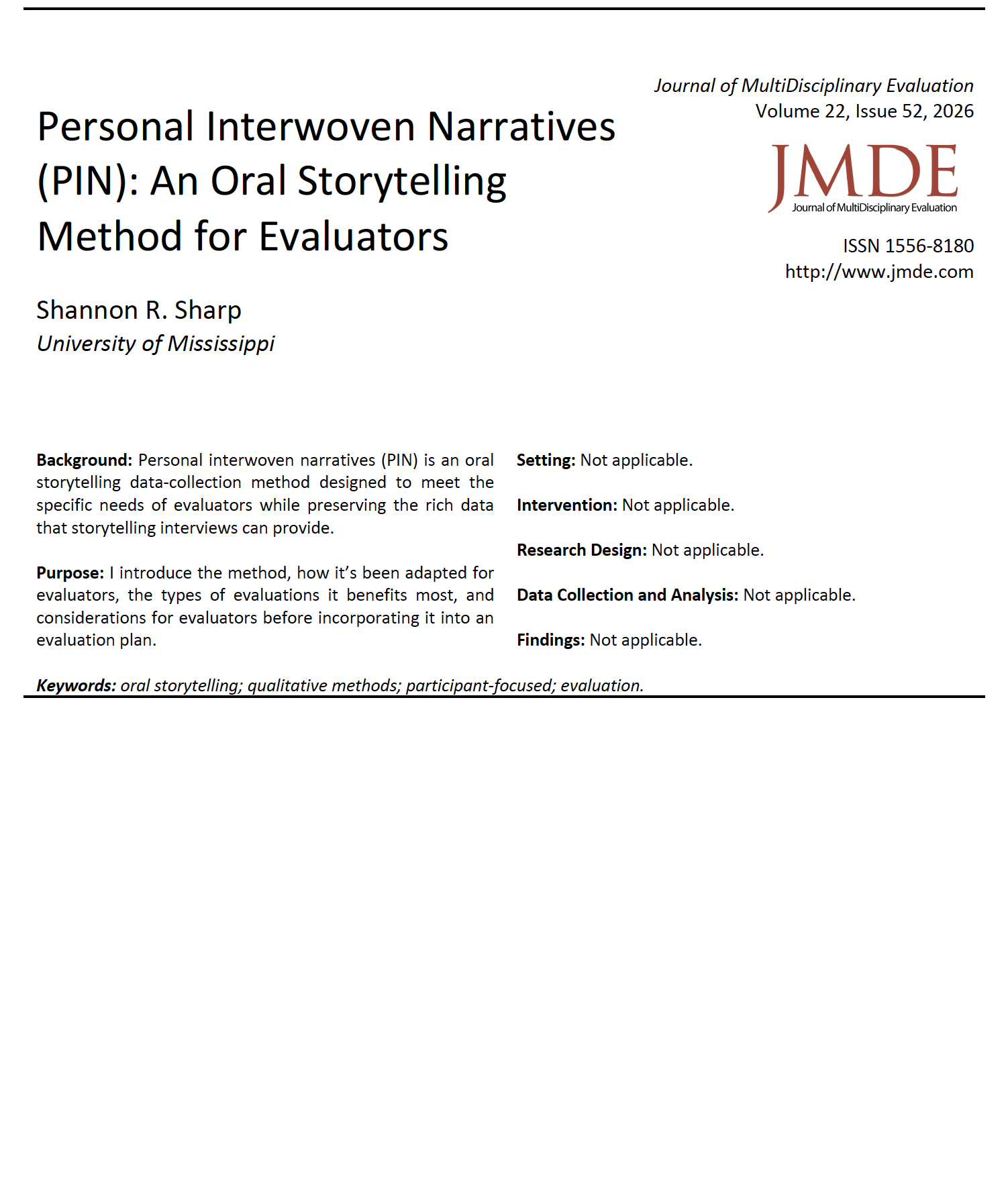
Personal Interwoven Narratives (PIN): An Oral Storytelling Method for Evaluators
Article Sidebar
Main Article Content
Abstract
Oral storytelling methods, such as oral history, are not often incorporated into program evaluations; as evaluators, we tend to develop interview protocols that are more structured. In this paper, I explain how evaluators can use Personal Interwoven Narratives (PIN), a method adapted from oral history, as a more open-ended approach to collect richer, fuller data than more-structured interviews tend to provide. Though not appropriate for all evaluations, PIN can greatly benefit evaluations that aim to honor stories and raise the voices of marginalized or otherwise underheard groups. I will describe how the Personal Interwoven Narratives method developed from the established oral history technique into an oral storytelling method that specifically meets evaluators’ needs, what types of evaluations it most benefits, and best practices and considerations for evaluators who seek to use this new method.
Downloads
Article Details

This work is licensed under a Creative Commons Attribution-NonCommercial 4.0 International License.
Copyright and Permissions
Authors retain full copyright for articles published in JMDE. JMDE publishes under a Creative Commons Attribution-NonCommercial 4.0 International License (CC BY - NC 4.0). Users are allowed to copy, distribute, and transmit the work in any medium or format for noncommercial purposes, provided that the original authors and source are credited accurately and appropriately. Only the original authors may distribute the article for commercial or compensatory purposes. To view a copy of this license, visit creativecommons.org
Funding data
-
National Institute of General Medical Sciences
Grant numbers UL1GM118976;TL4GM118977
References
American Evaluation Association. (n.d.). American Evaluation Association guiding principles for evaluators. https://www.eval.org/About/Guiding-Principles
Cambridge Dictionary. (n.d.). Reflexivity. In Cambridge Dictionary. Retrieved May 2026 from https://dictionary.cambridge.org/dictionary/english/ reflexivity
Henwood, K. (2008). Qualitative research, reflexivity and living with risk: Valuing and practicing epistemic reflexivity and centering marginality. Qualitative Research in Psychology, 5, 45–55. DOI: https://doi.org/10.1080/14780880701863575
Holland, R. (1999). Reflexivity. Human relations, 52(4), 463–484. DOI: https://doi.org/10.1177/001872679905200403
Hollander, J. A. (2004). The social contexts of focus groups. Journal of Contemporary Ethnography, 33(5), 602–637. DOI: https://doi.org/10.1177/0891241604266988
Kirby, S. L., Greaves, L., & Reid, C. (2017). Experience research social change: Methods beyond the mainstream. University of Toronto Press.
Leavy, P. (2011). Oral history: Understanding qualitative research. Oxford University Press. DOI: https://doi.org/10.1093/acprof:osobl/9780195395099.001.0001
Lummis, T. (1988). Introduction. In listening to history: The authenticity of oral evidence (pp. 11–15). Rowan & Littlefield.
Morgan, G. A., & Harmon, R. J. (2001). Data collection techniques. Journal of the American Academy of Child & Adolescent Psychiatry, 40(8), pp. 973–976. DOI: https://doi.org/10.1097/00004583-200108000-00020
Office of Data, Analysis, Research & Evaluation Administration on Children, Youth & Families. (2016). Qualitative research methods in program evaluation: Considerations for federal staff. https://acf.gov/sites/default/files/documents/acyf/qualitative_research_methods_in_program_evaluation.pdf
Oral history. (2026, February 16). In Wikipedia. https://en.wikipedia.org/wiki/Oral_history
Oral History Association. (n.d.-a). Oral history best practices. https://oralhistory.org/best-practices/
Oral History Association. (n.d.-b). Principles and Best Practices Glossary. https://oralhistory.org/best-practices-glossary/
Palacios, J. F., Salem, B., Hodge, F. S., Albarran, C. R., Anabere, A., & Hayes-Bautista, T. M. (2014). Storytelling: A qualitative tool to promote health among vulnerable populations. Journal of Transcultural Nursing, 26(4), 346–353. DOI: https://doi.org/10.1177/1043659614524253
Patton, M. Q. (1987). Qualitative research evaluation methods. Sage Publishers.
Patton, M. Q. (2008). Utilization-focused evaluation (4th ed.), Oxford University Press.
Patton, M. Q. (2015). Qualitative research and evaluation methods: Integrating theory and practice (4th ed.). Sage Publications.
Portelli, A. (2015). What makes oral history different. In R. Perks & A. Thompson (Eds.), The oral history reader (3rd ed., pp. 48–57). Routledge.
Robinson, O., & Wilson, A. (2022). Practicing and presenting social research. UBC Library.
Schoonenboom, J., & Johnson, R. B. (2017). How to construct a mixed methods research design. Cologne Journal of Sociology and Social Psychology, 62(2), 107–131. DOI: https://doi.org/10.1007/s11577-017-0454-1
Sharp, S. R. (2024, October 26). Oral histories: A method for amplifying and empowering underrepresented voices [Conference presentation]. Evaluation (AEA) 2024, Portland, OR, United States.
Sharp, S. R., Lin, J. C. P., Kwan, P. P., Mason, S., Wilkerson, J., & Grayson, A. (2024). Oral history in evaluation: A new partnership to expand and enhance both fields. The Oral History Review, 51(1), 70–88. https://doi.org/10.1080/00940798.2023.2284391 DOI: https://doi.org/10.1080/00940798.2023.2284391
Yarmey, N. (2026). Evaluation questions. Eval Academy. https://www.evalacademy.com/eval-terms/evaluation-questions