
Making the Implicit Explicit: A Theory-Informed Reflective Case of Emergent Evaluation Capacity Building in a Public Training Institution
Article Sidebar
Main Article Content
Abstract
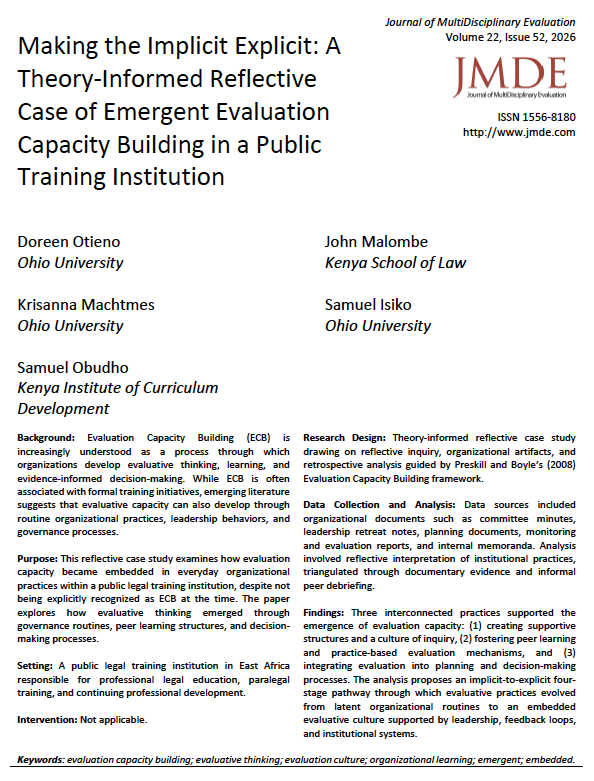
This reflective essay revisits a period of institutional reform within a public sector institution in East Africa, where evaluation capacity (ECB) practices emerged through routine, embedded practices in daily operations. Using Preskill and Boyle’s (2008) model as a lens, the essay reinterprets these embedded practices to make the implicit explicit. Three domains are highlighted: creating supportive structures and culture, building communities of practice, and integrating evaluation into planning and decision-making, all reinforced by leadership that modeled and sustained evaluative habits. The reflection also surfaces the tensions between theory and practice, showing how ECB unfolds in complex institutional realities, where tensions can open spaces for learning and adaptation. Ultimately, the essay contributes to ECB scholarship by demonstrating how capacity can develop organically through institutional routines and by bridging practitioner experience with scholarly frameworks.
Downloads
Article Details

This work is licensed under a Creative Commons Attribution-NonCommercial 4.0 International License.
Copyright and Permissions
Authors retain full copyright for articles published in JMDE. JMDE publishes under a Creative Commons Attribution-NonCommercial 4.0 International License (CC BY - NC 4.0). Users are allowed to copy, distribute, and transmit the work in any medium or format for noncommercial purposes, provided that the original authors and source are credited accurately and appropriately. Only the original authors may distribute the article for commercial or compensatory purposes. To view a copy of this license, visit creativecommons.org
References
Argyris, C., & Schön, D. A. (1997). Organizational learning: A theory of action perspective. Reis, 77/78, 345–348. DOI: https://doi.org/10.2307/40183951
Bamberger, M., Vaessen, J., & Raimondo, E. (Eds.). (2015). Dealing with complexity in development evaluation: A practical approach. Sage Publications. DOI: https://doi.org/10.4135/9781483399935
Boswell, C. (2009). The political uses of expert knowledge: Immigration policy and social research. Cambridge University Press. DOI: https://doi.org/10.1017/CBO9780511581120
Buckley, J., Archibald, T., Hargraves, M., & Trochim, W. M. (2015). Defining and teaching evaluative thinking: Insights from research on critical thinking. American Journal of Evaluation, 36(3), 375–388. https://doi.org/10.1177/1098214015581706 DOI: https://doi.org/10.1177/1098214015581706
Chaytor, K. (2023). Building evaluation cultureThe missing link. Canadian Journal of Program Evaluation, 37(3), 422–438. https://doi.org/10.3138/cjpe.75431 DOI: https://doi.org/10.3138/cjpe.75431
Christie, C. A., & Fierro, L. A. (2012). Evaluation policy to implementation: An evaluation of scientifically based research in practice. Studies in Educational Evaluation, 38(2), 65–72. https://doi.org/10.1016/j.stueduc.2012.05.003 DOI: https://doi.org/10.1016/j.stueduc.2012.05.003
Compton, D. W., & Baizerman, M. (2007). Defining evaluation capacity building. American Journal of Evaluation, 28(1), 118–119. https://doi.org/10.1177/1098214006298172 DOI: https://doi.org/10.1177/1098214006298172
Cousins, J. B., Goh, S. C., Clark, S., & Lee, L. E. (2004). Integrating evaluative inquiry into the organizational culture: A review and synthesis of the knowledge base. Canadian Journal of Program Evaluation, 19(2), 99–141. https://doi.org/10.3138/cjpe.19.006 DOI: https://doi.org/10.3138/cjpe.19.006
Cousins, J. B., Goh, S. C., Elliott, C. J., & Bourgeois, I. (2014). Framing the capacity to do and use evaluation. New Directions for Evaluation, 141, 7–23. https://doi.org/10.1002/ev.20076 DOI: https://doi.org/10.1002/ev.20076
Cousins, J. B., & Whitmore, E. (1998). Framing participatory evaluation. New Directions for Evaluation, 80, 5–23. DOI: https://doi.org/10.1002/ev.1114
Feldman, M. S., & Pentland, B. T. (2003). Reconceptualizing organizational routines as a source of flexibility and change. Administrative Science Quarterly, 48(1), 94–118. https://doi.org/10.2307/3556620 DOI: https://doi.org/10.2307/3556620
Fetterman, D. M. (2001). Foundations of empowerment evaluation. Sage.
Fetterman, D. M. (2023). Empowerment evaluation and social justice: Confronting the culture of silence. Guilford Publications.
Fetterman, D. M., Rodriguez-Campos, L., & Zukoski, A. P. (2018). Collaborative, participatory and empowerment evaluation: Stakeholder involvement approaches. Health Promotion Journal of Australia, 29(3), 363.
Fetterman, D. M., & Wandersman, A. (Eds.). (2005). Empowerment evaluation principles in practice. Guilford Press.
Fierro, L. A., Bourgeois, I., Gokiert, R., Searle, M., & Tremblay, M. (2024). Strengthening evaluation capacity building practice through competition: The Max Bell School of Public Policy’s Evaluation Capacity Case Challenge. Canadian Journal of Program Evaluation, 38(3), 521–531. https://doi.org/10.3138/cjpe-2024-0012 DOI: https://doi.org/10.3138/cjpe-2024-0012
Goodyear, L., Mansori, S., Quinlan, K., McMahon, T., & Kyles, C. M. (2024). Evaluation capacity building in theory and practice: Revisiting models from practitioner perspectives. New Directions for Evaluation, 183, 29–41. https://doi.org/10.1002/ev.20613 DOI: https://doi.org/10.1002/ev.20613
Holmes, A. G. D. (2020). Researcher positionalityA consideration of its influence and place in qualitative researchA new researcher guide. Shanlax International Journal of Education, 8(4), 1–10. DOI: https://doi.org/10.34293/education.v8i4.3232
Johnson, G., Langley, A., Melin, L., & Whittington, R. (Eds.). (2007). Strategy as practice: Research directions and resources. Cambridge University Press. DOI: https://doi.org/10.1017/CBO9780511618925
Konjore, M. J. (2024). Two decades of evaluating evaluation capacity building: A bibliographic coupling review. New Directions for Evaluation, 183, 11–28. https://doi.org/10.1002/ev.20616 DOI: https://doi.org/10.1002/ev.20616
Labin, S. N., Duffy, J. L., Meyers, D. C., Wandersman, A., & Lesesne, C. A. (2012). A research synthesis of the evaluation capacity building literature. American Journal of Evaluation, 33(3), 307–338. https://doi.org/10.1177/1098214011434608 DOI: https://doi.org/10.1177/1098214011434608
Lee, L. E., & Cousins, J. B. (2004). Participation in evaluation of funded school improvement: Effects and supporting conditions. In Participatory Evaluation in Education (pp. 87–100). Routledge. DOI: https://doi.org/10.4324/9780203695104-14
Lipsky, M. (2010). Street-level bureaucracy: Dilemmas of the individual in public service. Russell Sage Foundation.
Mayne, J. (2008). Contribution analysis: An approach to exploring cause and effect (ILAC Brief No. 16). Institutional Learning and Change (ILAC) Initiative, Bioversity International. https://hdl.handle.net/10568/70124
McDonald, B., Rogers, P., & Kefford, B. (2003). Teaching people to fish? Building the evaluation capability of public sector organizations. Evaluation, 9(1), 9–29. https://doi.org/10.1177/1356389003009001002 DOI: https://doi.org/10.1177/1356389003009001002
Nielsen, S. B., Fierro, L. A., Bourgeois, I., & Lemire, S. (2024). The science and practice of evaluation capacity building. Canadian Journal of Program Evaluation, 38(3), 425–432. https://doi.org/10.3138/cjpe-2024-0011 DOI: https://doi.org/10.3138/cjpe-2024-0011
Norton, S., Milat, A., Edwards, B., & Giffin, M. (2016). Narrative review of strategies by organizations for building evaluation capacity. Evaluation and program planning, 58, 1–19. https://doi.org/10.1016/j.evalprogplan.2016.04.004 DOI: https://doi.org/10.1016/j.evalprogplan.2016.04.004
Nutley, S. M., Walter, I., & Davies, H. T. (2007). Improving research use in policy contexts. In Using evidence (pp. 231–270). Policy Press. https://doi.org/10.51952/9781847422323.ch008 DOI: https://doi.org/10.51952/9781847422323.ch008
Patton, M. Q. (2008). Utilization-focused evaluation. Sage Publications.
Patton, M. Q. (2011). Essentials of utilization-focused evaluation. Sage Publications.
Pettigrew, A., & McNulty, T. (1995). Power and influence in and around the boardroom. Human Relations, 48(8), 845–873. https://doi.org/10.1177/001872679504800802 DOI: https://doi.org/10.1177/001872679504800802
Pollitt, C., & Bouckaert, G. (2017). Public management reform: A comparative analysisInto the age of austerity. Oxford University Press.
Preskill, H., & Boyle, S. (2008). A multidisciplinary model of evaluation capacity building. American Journal of Evaluation, 29(4), 443–459. https://doi.org/10.1177/1098214008324182 DOI: https://doi.org/10.1177/1098214008324182
Schein, E. H. (2010). Organizational culture and leadership (Vol. 2). John Wiley & Sons.
Schön, D. A. (2017). The reflective practitioner: How professionals think in action. Routledge. (Original work published 1983)
Searle, M., Fierro, L. A., Pinarski, J., Dixon, L., Tremblay, M., Bourgeois, I., & Gokiert, R. (2024). Meeting the challenge: How the City of Kingston is working to propel evaluation growth. Canadian Journal of Program Evaluation, 38(3), 555–565. https://doi.org/10.3138/cjpe-2024-0006 DOI: https://doi.org/10.3138/cjpe-2024-0006
Stake, R. E. (1995). The art of case study research. Sage Publications.
Stockdill, S. H., Baizerman, M., & Compton, D. W. (2002). Toward a definition of the ECB process: A conversation with the ECB literature. New Directions for Evaluation, 93, 1–25. DOI: https://doi.org/10.1002/ev.38
Suarez-Balcazar, Y., & Taylor-Ritzler, T. (2013). Moving from science to practice in evaluation capacity building. American Journal of Evaluation, 35(1), 95–99. https://doi.org/10.1177/1098214013499440 DOI: https://doi.org/10.1177/1098214013499440
Taut, S. (2007). Studying self-evaluation capacity building in a large international development organization. American Journal of Evaluation, 28(1), 45–59. https://doi.org/10.1177/1098214006296430 DOI: https://doi.org/10.1177/1098214006296430
Taylor-Ritzler, T., Suarez-Balcazar, Y., Garcia-Iriarte, E., Henry, D. B., & Balcazar, F. E. (2013). Understanding and measuring evaluation capacity: A model and instrument validation study. American Journal of Evaluation, 34(2), 190–206. https://doi.org/10.1177/1098214012471421 DOI: https://doi.org/10.1177/1098214012471421
Weick, K. E., & Weick, K. E. (1995). Sensemaking in organizations (Vol. 3, No. 10.1002). Sage Publications.
Weiss, C. H. (2021). The many meanings of research utilization. In Social science and social policy (pp. 31–40). Routledge. DOI: https://doi.org/10.4324/9781003246299-3
Weiss, C. H. (1979). THE MANY MEANINGS OF RESEARCH UTILIZATION. Public Administration Review, 39(5). https://doi. 10.2307/3109916 DOI: https://doi.org/10.2307/3109916
Yip, S. Y. (2024). Positionality and reflexivity: Negotiating insider-outsider positions within and across cultures. International Journal of Research & Method in Education, 47(3), 222–232. https://doi.org/10.1080/1743727X.2023.2266375 DOI: https://doi.org/10.1080/1743727X.2023.2266375