
Using Creative Methods to Elevate Youth Voice to Understand Why Youth from Low-Income Backgrounds Return and Do Not Return to Camp
Article Sidebar
Main Article Content
Abstract
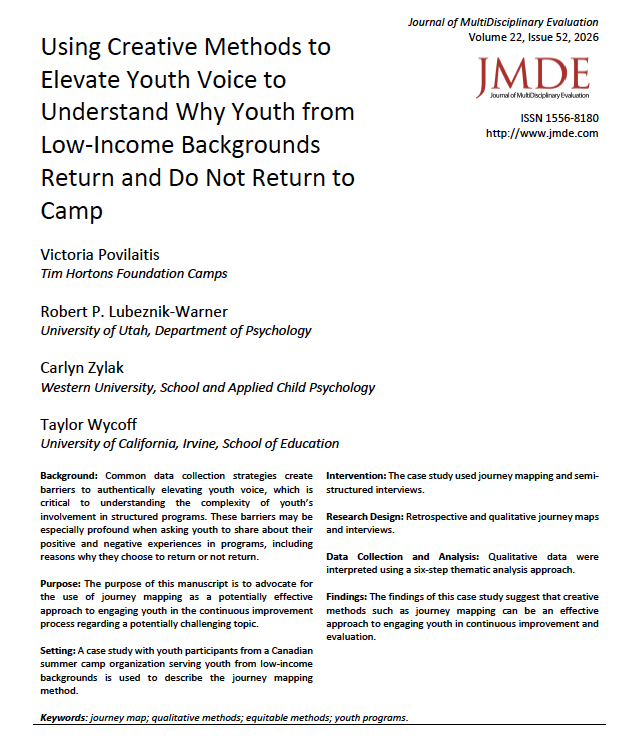
Background: Common data collection strategies create barriers to authentically elevating youth voice, which is critical to understanding the complexity of youth’s involvement in structured programs. These barriers may be especially profound when asking youth to share about their positive and negative experiences in programs, including reasons why they choose to return or not return. Purpose: The purpose of this paper is to highlight the use of journey mapping as a potentially effective approach to engaging youth in the continuous improvement process regarding a potentially challenging topic. Setting: The evaluation took place with youth participants from a Canadian summer camp organization serving youth from low-income backgrounds. Intervention: The evaluation method employed creative methods, specifically journey mapping, and semi-structured interviews. Research Design: Retrospective and qualitative. Data Collection and Analysis: Qualitative data were interpreted using a six-step thematic analysis approach. Findings: The findings of this case study suggest that creative methods, such as journey mapping, can be an effective approach to engaging youth from marginalized backgrounds in continuous improvement and evaluation.
Downloads
Article Details

This work is licensed under a Creative Commons Attribution-NonCommercial 4.0 International License.
Copyright and Permissions
Authors retain full copyright for articles published in JMDE. JMDE publishes under a Creative Commons Attribution-NonCommercial 4.0 International License (CC BY - NC 4.0). Users are allowed to copy, distribute, and transmit the work in any medium or format for noncommercial purposes, provided that the original authors and source are credited accurately and appropriately. Only the original authors may distribute the article for commercial or compensatory purposes. To view a copy of this license, visit creativecommons.org
References
Baldwin C. K., Stromwall, K., & Wilder, Q. (2015). Afterschool youth program design and structural quality: Implications for quality improvement. Child & Youth Services, 36(3), 226–47. https://doi.org/10.1080/0145935X.2015.1046592 DOI: https://doi.org/10.1080/0145935X.2015.1046592
Blakeslee, J. E., & Walker, J. S. (2018). Assessing the meaningful inclusion of youth voice in policy and practice: State of the science. Research and Training Center for Pathways to Positive Futures, Portland State University.
Braun, V. & Clarke, V. (2006). Using thematic analysis in psychology. Qualitative Research in Psychology, 3, 77–101. https://doi.org/10.1191/1478088706qp063oa DOI: https://doi.org/10.1191/1478088706qp063oa
Browne, L. P., Jameson, M., & Bialeschki, M. D. (2015). Engaging camp staff in continuous program improvement. Journal of Park and Recreation Administration, 33(1), 40–56.
Bulto, L. N., Davies, E., Kelly, J., & Hendricks, J. M. (2024). Patient journey mapping: Emerging methods for understanding and improving patient experiences of health systems and services. European Journal of Cardiovascular Nursing, 23(4), 429–433. https://doi.org/10.1093/eurjcn/zvae012 DOI: https://doi.org/10.1093/eurjcn/zvae012
Connell, E., Petersen, A., & Teng, M. (2023). Utilizing journey mapping to evaluate youth programs and social service systems: Case studies. Journal of MultiDisciplinary Evaluation, 19(45), 19–33. https://doi.org/10.56645/jmde.v19i45.723 DOI: https://doi.org/10.56645/jmde.v19i45.723
Fountain, S., Hale, R., Spencer, N., Morgan, J., James, M., & Stewart, M. K. (2021). A 10-year systematic review of photovoice projects with youth in the United States. Health Promotion Practice, 22(6). https://doi.org/10.1177/15248399211019978 DOI: https://doi.org/10.1177/15248399211019978
Habermas, T., & Bluck, S. (2000). Getting a life: The emergence of the life story in adolescence. Psychological Bulletin, 126(5), 748–769. https://doi.org/10.1037/0033-2909.126.5.748 DOI: https://doi.org/10.1037/0033-2909.126.5.748
Hadfield, M., & Haw, K. (2001). ‘Voice’, young people and action research. Educational Action Research, 9(3), 485–499. https://doi.org/10.1080/09650790100200165 DOI: https://doi.org/10.1080/09650790100200165
Krenichyn, K., Schaefer-McDaniel, N., Clark, H., & Zeller-Berkman, S. (2007). Where are young people in youth program evaluation research? Children, Youth and Environments, 17(2), 594–615. DOI: https://doi.org/10.1353/cye.2007.0083
Lincoln, Y., & Guba, E. G. (1985). Naturalistic inquiry. Sage. DOI: https://doi.org/10.1016/0147-1767(85)90062-8
Lubeznik-Warner, R. P., Froehly, M., Wycoff, T., Povilaitis, V., Cloward, L., Taylor, S., & Moon, S. (2024). Narratives about memorable camp experiences: Fostering growth in youth from low-income backgrounds. Journal of Experiential Education, 47(2). https://doi.org/10.1177/10538259231223463 DOI: https://doi.org/10.1177/10538259231223463
Nowell, L. S., Norris, J. M., White, D. E., & Moules, N. J. (2017). Thematic analysis: Striving to meet the trustworthiness criteria. International Journal of Qualitative Methods, 16, 1–13. https://doi.org/10.1177/1609406917733847 DOI: https://doi.org/10.1177/1609406917733847
Povilaitis, V., Warner, R., & Wheatley, K. M. (2023). The lasting benefits of multiyear camp programming for youth from low-income backgrounds. Journal of Youth Development, 18(1), 61–69. https://doi.org/10.34068/jyd.18.01.07 DOI: https://doi.org/10.34068/JYD.18.01.07
Putnam, R. D. (2015). Our kids: The American dream in crisis. Simon & Schuster.
Rosenbaum, M. S., Otalora, M. L., & Ramírez, G. C. (2017). How to create a realistic customer journey map. Business Horizons, 60(1), 143–150. https://doi.org/10.1016/j.bushor.2016.09.010 DOI: https://doi.org/10.1016/j.bushor.2016.09.010
Sabo Flores, K. (2007). Youth participatory evaluation: Strategies for engaging young people. Jossey-Bass.
Shapiro-Franklin, N. Cortes, M., & Gillard, A. (2025, February). Using photovoice to explore sense of belonging at a medical specialty camp [Conference presentation]. American Camp Association Annual Conference, Dallas, Texas. https://www.acacamps.org/sites/default/files/2025-02/2025-ACA-Camp-Research-Book-of-Abstracts.pdf
Spielvogel, B., Lubeznik-Warner, R. P., Sibthorp, J., & Browne, L. P. (2024). A national longitudinal study examining social-emotional benefits of summer camp for early adolescents: Effects of attendance, dosage, and experience quality. Journal of Leisure Research, 1–21. https://doi.org.10.1080/00222216.2024.2424194 DOI: https://doi.org/10.1080/00222216.2024.2424194
Strachan, L. & Davies, K. (2015). Click! Using photo elicitation to explore youth experiences and positive youth development in sport. Qualitative Research in Sport, Exercise and Health, 7(2), 170–191. https://doi.org/10.1080/2159676X.2013.867410 DOI: https://doi.org/10.1080/2159676X.2013.867410
Sutton-Brown, C. A. (2014). Photovoice: A methodological guide. Photography and Culture, 7(2), 169–185. https://doi.org/10.2752/175145214X13999922103165 DOI: https://doi.org/10.2752/175145214X13999922103165
Tichnor-Wagner, A., Wachen, J., Cannata, M., & Cohen-Vogel, L. (2017). Continuous improvement in the public school context: Understanding how educators respond to plan-do-study-act cycles. Journal of Educational Change, 18, 465–94. DOI: https://doi.org/10.1007/s10833-017-9301-4
Wilson, N., Dasho, S., Martin, A. C., Wallerstein, N., Wang, C. C. & Minkler, M. (2007). Engaging young adolescents in social action through photovoice: The Youth Empowerment Strategies (YES!) project. The Journal of Early Adolescence, 27(2). https://doi.org/10.1177/0272431606294834 DOI: https://doi.org/10.1177/0272431606294834
Yonas, M. A., Burke, J. G., Rak, K., Bennett, A., Kelly, V., & Gilen, A. C. (2009). A picture’s worth a thousand words: Engaging youth in CBPR using the creative arts. Progress in Community Health Partnerships: Research, Education, and Action, 3(4), 349–358. DOI: https://doi.org/10.1353/cpr.0.0090