
Applying an Indigenous Evaluation Framework in Reshaping a Youth Skills and Pre-Employment Program
Article Sidebar
Main Article Content
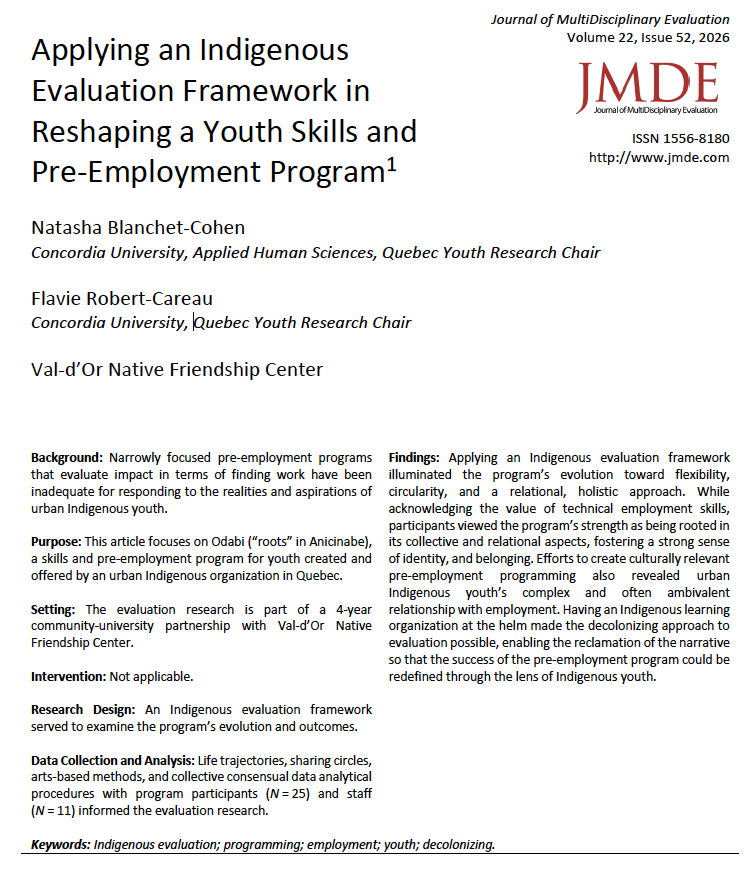
Abstract
Background: Narrowly focused pre-employment programs that evaluate impact in terms of finding work have been considered inadequate for meeting the realities and needs of urban Indigenous youth.
Purpose: This article focuses on Odabi (“roots” in Anicinabe), a skills and employment program for youth created and offered by an urban Indigenous organization in Quebec
Setting: The study is part of a 4-year community-university partnership with [removed for anonymity]
Research design: An Indigenous evaluation framework served to examine the evolution and program’s impact from the participants’ perspective.
Data collection & analysis: Informing the study was a combination of participant observation, participatory group activities, sharing circles, and individual interview with program participants (25) and staff (11).
Findings: The evaluation research shows that reshaping the program involved broadening the definition of success to encompass a comprehensive Indigenous view of well-being that is greater than finding and maintaining a job. Participants tell the story of what counts in terms of the program being rooted in the collective and group aspect, suggesting that the technical aspects of employment should not be at the program’s core, but rather the relational component and the strengthening of the sense of identity and pride.
Downloads
Article Details

This work is licensed under a Creative Commons Attribution-NonCommercial 4.0 International License.
Copyright and Permissions
Authors retain full copyright for articles published in JMDE. JMDE publishes under a Creative Commons Attribution-NonCommercial 4.0 International License (CC BY - NC 4.0). Users are allowed to copy, distribute, and transmit the work in any medium or format for noncommercial purposes, provided that the original authors and source are credited accurately and appropriately. Only the original authors may distribute the article for commercial or compensatory purposes. To view a copy of this license, visit creativecommons.org
Funding data
-
Fonds de Recherche du Québec-Société et Culture
Grant numbers 2019-SJ-265147
References
Blanchet-Cohen, N., Cloutier, E., Lévesque, C., Laroche, S., & Wawanoloath, M.-A. (2021). Moving toward Indigenous-centred perinatal care in urban Quebec. International Journal of Indigenous Health, 16(2), 54–69. https://doi.org/10.32799/ijih.v16i2.33211 DOI: https://doi.org/10.32799/ijih.v16i2.33211
Blanchet-Cohen, N., Pinsonneault, A., & Fontaine-Dumais, S. (2022). Aide à l’emploi pour les jeunes Autochtones en milieu urbain. Des services culturellement sécurisants [Employment assistance for urban Aboriginal youth. Culturally safe services]. In A. Lechaume, C. Fleury, & C. Prévost, Les diversités en emploi. Perspectives et enjeux au Québec et au Canada (pp. 307–332). Presse de l’Université Laval. DOI: https://doi.org/10.2307/j.ctv2j6xpzq.14
Caron, J., Asselin, H., & Beaudoin, J.-M. (2020). Indigenous employees’ perceptions of the strategies used by mining employers to promote their recruitment, integration and retention. Resources Policy, 68, Article 101793. https://doi.org/10.1016/j.resourpol.2020.101793 DOI: https://doi.org/10.1016/j.resourpol.2020.101793
Chilisa, B. (2020). Indigenous research methodologies (2nd ed.). Sage.
Chilisa, B., & Bowman, N. R. (2023). Special issue editors’ introductory note: The why and how of the decolonization discourse. Journal of MultiDisciplinary Evaluation, 19(44), 2–10. https://doi.org/10.56645/jmde.v19i44.919 DOI: https://doi.org/10.56645/jmde.v19i44.919
Deschênes, E. (2025). Insertion socioprofessionnelle et maintien en emploi des jeunes des Premières Nations et Inuit. Enjeux et défis, besoins et intérêts, stratégies et pratiques [Socio-professional integration and job retention for First Nations and Inuit youth: Issues and challenges, needs and interests, strategies and practices]. Institut Ashukan.
Dinku, Y. (2021). A longitudinal analysis of economic inactivity among Indigenous youth. Australian Journal of Labour Economics, 24(1), 25–45. https://www.curtin.edu.au/resources/file/faculty/fbl/AJLE-Vol-24-No-1-Paper-2.pdf DOI: https://doi.org/10.3316/informit.046725824351883
Fast, E., Nutton, J., De La Sablonnière-Griffin, M., Kozlowski, A., Bertrand, N., Bertrand, S., & Mitchell, J. (2016, October 4). Regard sur l’interaction de l’urbanisation, du traumatisme historique et de l’identité culturelle parmi la jeunesse autochtone au Canada [The interplay between urbanization, historical trauma and cultural identity among Indigenous youth in Canada]. Enfances Familles Générations. Revue interdisciplinaire sur la famille contemporaine, 25. https://journals.openedition.org/efg/1134
First Nations and Inuit Labour Market Advisory Committee. (2023). The First Nations and Inuit labour market of Quebec. https://www.ccpnimt-fnilmac.com/wp-content/uploads/2023/09/first-nations-and-inuit-labour-market-of-quebec-report-CCPNIMT_ra23_eng.pdf
Fortin-Lefebvre, E., Awashish, K., & Blanchet-Cohen, N. (2023). Accompagnement à l’entrepreneuriat collectif des jeunes Autochtones : Un récit d’expérience d’autochtonisation [Support for collective entrepreneurship among Indigenous youth: An account of an experience of Indigenization]. Canadian Journal of Nonprofit and Social Economy Research, 14(S1), 122–137. https://doi.org/10.29173/cjnser555 DOI: https://doi.org/10.29173/cjnser555
Haar, J. M., & Brougham, D. M. (2013). An Indigenous model of career satisfaction: Exploring the role of workplace cultural well-being. Social Indicators Research, 110(3), 873–890. https://doi.org/10.1007/s11205-011-9962-y DOI: https://doi.org/10.1007/s11205-011-9962-y
Jewell, D. E., Doucet, A., Falk, J., & Fyke, S. (2020). Social knowing, mental health, and the importance of Indigenous resources: A case study of Indigenous employment engagement in Southwestern Ontario. Canadian Review of Social Policy, 80, 1–25.
Julien, M., Somerville, K., & Brant, J. (2017). Indigenous perspectives on work-life enrichment and conflict in Canada. Equality, Diversity and Inclusion: An International Journal, 36(2), 165–181. https://doi.org/10.1108/EDI-11-2015-0096 DOI: https://doi.org/10.1108/EDI-11-2015-0096
Landry, V., Asselin, H., & Lévesque, C. (2019). Link to the land and mino-pimatisiwin (comprehensive health) of Indigenous people living in urban areas in Eastern Canada. International Journal of Environmental Research and Public Health, 16(23), 4782. https://doi.org/10.3390/ijerph16234782 DOI: https://doi.org/10.3390/ijerph16234782
Levac, L., McMurtry, L., Stienstra, D., Baikie, G., Hanson, C., & Mucina, D. (2018). Learning across Indigenous and Western knowledge systems and intersectionality: Reconciling social science research approaches. University of Guelph.
Lévesque, C., Cloutier, E., Radu, I., Parent-Manseau, D., Laroche, S., & Blanchet-Cohen, N. (2019). Taking action to improve Indigenous health in the cities of Québec and Canada: The example of the Minowé Clinic at the Val-d’Or Native Friendship Center. In I. Vojnovic, A. Pearson, G. DeVerteuil, & A. Allen (Eds.), Handbook of global urban health (pp. 347–362). Routledge. DOI: https://doi.org/10.4324/9781315465456-22
Locklear, S., Hesketh, M., Begay, N., Brixey, J., Echo-Hawk, A., & James, R. (2023). Reclaiming our narratives: An Indigenous evaluation framework for urban American Indian/Alaska Native communities. Canadian Journal of Program Evaluation, 38(1), 8–26. https://doi.org/10.3138/cjpe.75518 DOI: https://doi.org/10.3138/cjpe.75518
Longo, M. E., Bidart, C., Alfonsi, J., Noël, M., & Berthet, T. (2020). Le rapport au travail : Mise en lumière de l’agentivité des jeunes en situation de vulnérabilité au Québec et en France [The relationship to work: Highlighting the agency of youth in vulnerable situations in Quebec and France]. Revue Jeunes et Société, 5(2), 33–58. https://doi.org/10.7202/1085571ar DOI: https://doi.org/10.7202/1085571ar
MacKinnon, S. (2015). Decolonizing employment: Aboriginal inclusion in Canada’s labour market. University of Manitoba Press. DOI: https://doi.org/10.1515/9780887554674
Nadeau, M., Tibbitts, V., Eagle, R., & Dobervich, G. (2023). Creating and implementing an Indigenous evaluation framework process with Minnesota tribes. Canadian Journal of Program Evaluation, 38(1), 35–56. https://doi.org/10.3138/cjpe.75486 DOI: https://doi.org/10.3138/cjpe.75486
OECD. (2018). Indigenous employment and skills strategies in Canada. OECD Publishing. https://doi.org/10.1787/9789264300477-en DOI: https://doi.org/10.1787/9789264300477-en
Statistique Canada (2023). Données du recensement de 2021 [2021 census data]. Tableaux 98-10-0295-01; 98-10-0027-01; 98-10-0485-01; 98-10-0588-01. Gouvernement du Canada. https://www150.statcan.gc.ca/n1/fr/type/donnees?portlet_levels=98P%2C98P10%2C98P1010#tableaux
Statistics Canada. (2022, July 13). Répartition de la population autochtone selon la taille des centres de population, Québec, 2021 [Distribution of the Indigenous population by population centre size, Quebec, 2021]. https://www12.statcan.gc.ca/census-recensement/2021/as-sa/fogs-spg/alternative.cfm?topic=8&lang=F&dguid=2021A000224&objectId=3
St-Cyr, G. (Ed.). (2019). Revue de littérature NIKA. Favoriser la participation active des travailleurs autochtones au marché du travail québécois [Literature review: Project NIKA. Fostering the participation of Indigenous workers in the Quebec labour market]. Axtra: Alliance des centres-conseils en emplois. http://axtra.ca/wp-content/uploads/2019/01/NIKA_Revue-de-litterature_2019.pdf
Théberge, D., Beaudoin, J.-M., Asselin, H., Ben Mansour, J., Bouthiller, L., St-Jean, É., & Fabi, B. (2019). Regards sur les attitudes et comportements des employeurs à l’égard de la diversité de la main-d’œuvre autochtone (rapport global) [Views on the attitudes and behaviours of employers towards diversity in the Indigenous workforce. Overview report]. Université Laval. https://frq.gouv.qc.ca/app/uploads/2021/05/mra-rapport_jean-michel.beaudoin.pdf
Wilson, S. (2008). Research is ceremony: Indigenous research methods. Fernwood Publishing.
Youmans, A., Kutsyuruba, B., Butler, A., Godden, L., Hussain, A., Coe-Nesbitt, H., Stroud, R., & Deluca, C. (2023). Marginalized youth and their journey to work: A review of the literature. Education Thinking, 3(1), 61–82.